The Capitol Rotunda has eight massive paintings on its walls: The Landing of Columbus, The Baptism of Pocahontas, Embarkation of the Pilgrims, Discovery of the Mississippi by De Soto, The Declaration of Independence, The Surrender of General Burgoyne, The Surrender of Lord Cornwallis, and General George Washington Resigning His Commission.
The interior dome of the Rotunda features the “Apotheosis of Washington” mural. The first President of the United States is depicted as a seemingly Roman or Greek god ascending to the heavens surrounded by 13 “maidens” depicting the 13 colonies.
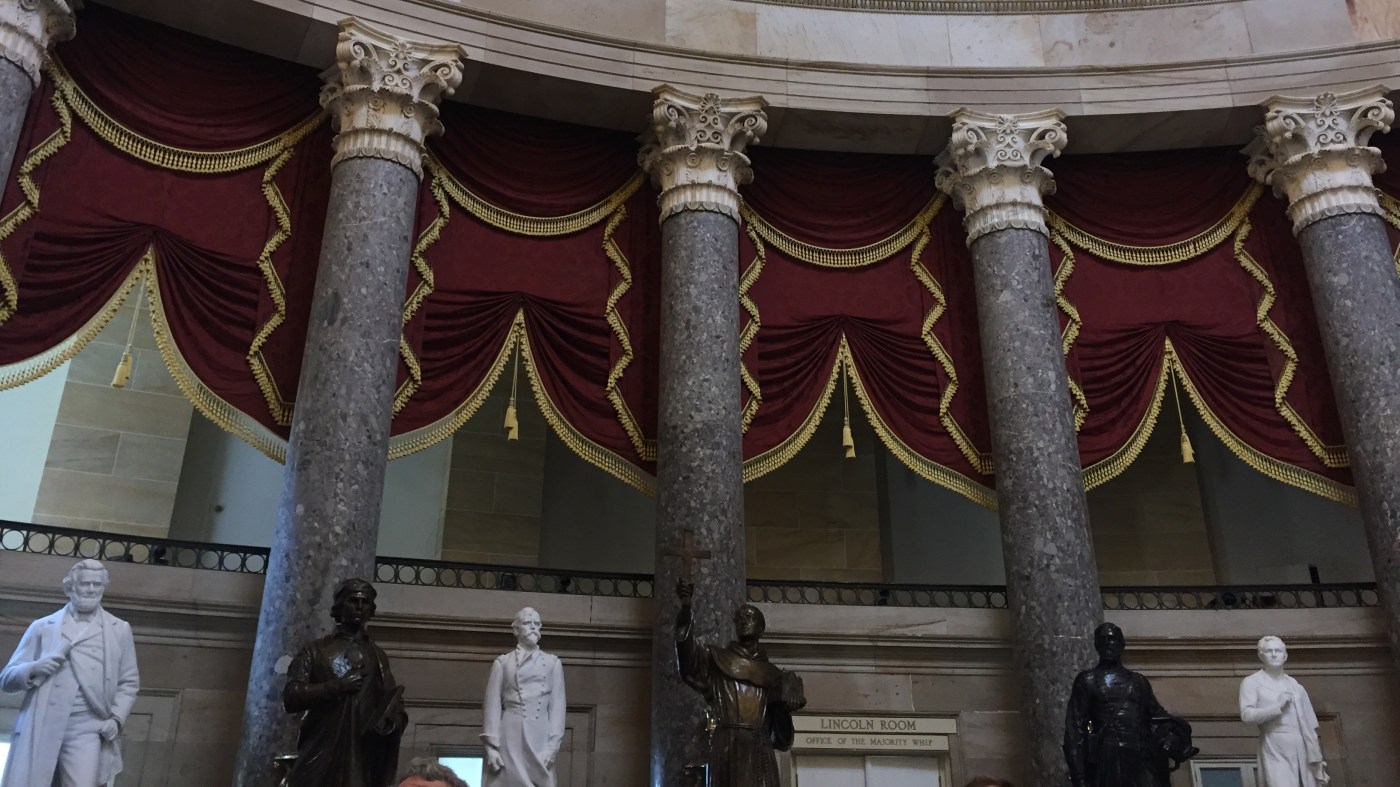
Just to the south of the Rotunda is the National Statuary Hall. Every state has two statues. Just this Wednesday Nebraska dedicated the statue of Ponca Chief Standing Bear in replacement of William Jennings Bryant. Yet this year, Willa Cather will replace Sterling Morton. (While the Chief and Willa are certainly noteworthy and maybe worthy of such a high honor as to have a statue in the Capitol, the cultural trend is to be rid of white men who have been repressive and the cause of much that is wrong in our country. I hope that was not the thinking of our legislature when they ruled to change our statues last year.) The only non-American statute in the Capitol is the bust of Winston Churchill.
A number of the men whose statues are in the Hall were talked about. The first was a pastor named Peter Muhlenberg whose father is called the patriarch of Lutheranism in America. Peter’s statue shows him in military garb with a robe coming off. The story is that he preached a sermon in his clerical garb then while still in the pulpit took off the robe and called his church men to join him in the Revolutionary War effort. Some 300 joined him. His brother, Frederick, also a pastor, initially fussed over Peter’s joining the war but after the British came into NYC, where he ministered, and burned 10 of the 19 church buildings including his and desecrated the other nine, Fredrick joined his brother in the war effort.
Fredrick became the first speaker of the House and both brothers served in writing the Bill of Rights again showing that it was not the First Amendment’s intent to keep faith out of government or they would have been putting themselves out of the Congress.
There is a statue of Richard Stockton who was captured and suffered under the British (some 11,000 Americans died in British ships converted into prisons – more than died by bullets) who when released and dying, wrote a summary of Christian doctrines to all his children.
The story was told of Dwight D. Eisenhower, whose grandparents were missionaries, who in 1903 fell and opened a wound on his knee which became infected and swollen so badly that they had to cut off his pants and shoe. The doctor was called and determined that the only way to save his life was to amputate the leg. Ike had his older brother, Edgar, swear that he would not let them take his leg. Edgar stopped the procedure and the next day Ike showed improvement and then recovered. Ike believed that God had healed him and thus his many efforts to bring God into the forefront in D.C. He got “In God we trust” on all money, “one nation under God” in the pledge, the Congressional prayer breakfast started, and a chapel put into the Capitol, among other things.
There is a statue of Lew Wallace, a Civil War general who was challenged by Robert Ingersoll, a profound atheist, to disprove Christianity. Wallace set about the task and in doing so became a convert and wrote the novel, Ben Hur.
The men who stand in the Hall all have profound stories worthy of our knowing, appreciating, and emulating. Sorry that we know so little of them.
 a PK Musing
Leave a comment